The Dawn of Predictive Health

Leveraging AI and Machine Learning for Biophoton-Based Monitoring.


By Shakti Singh | 2025

This research explores how ultraweak light emissions from our bodies (biophotons), when analyzed by AI, can non-invasively predict diseases and monitor stress levels.

the science of intrinsic light

Every living cell emits ultraweak light signals. These are direct byproducts of metabolic activity, primarily from Reactive Oxygen Species (ROS).
  • High Detection Accuracy: ~90% accuracy in cell classification via spectral analysis.
  • Rapid Processing: AI-powered diagnosis in under 1 minute.
  • Extreme Sensitivity: 1000x weaker than firefly light; requires photon-counting CCDs.
experimental evidence

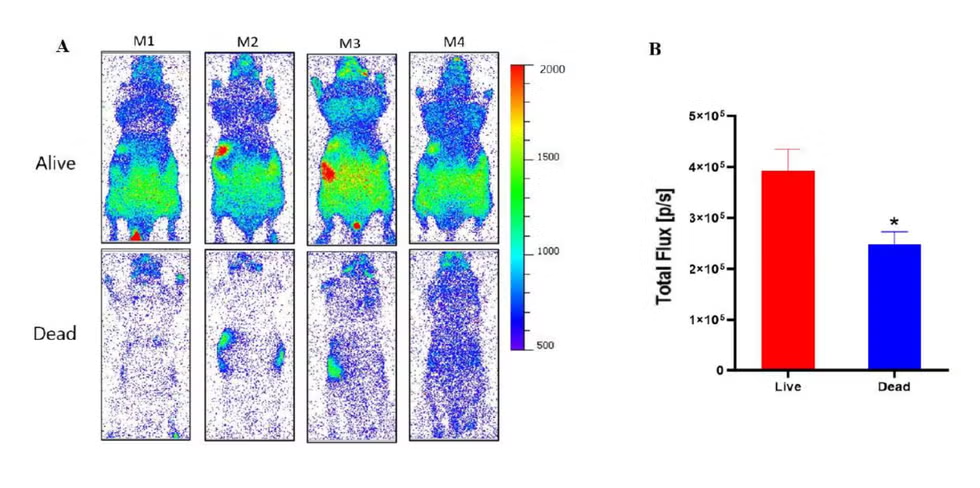
Ultraweak photon emissions (UPE) are a measurable phenomenon in living organisms.
Biophoton emission contrast between alive and dead biological systems
Fig 1: Biophoton emission contrast between alive and dead biological systems.
Schematic of human biophoton emission over time
Fig 2: Schematic of human biophoton emission over time, showcasing metabolic zones.

decoding disease signatures

Healthy and diseased tissues emit light differently. These unique "biophotonic signatures" allow us to distinguish between conditions with up to 90% accuracy.
Parameter Healthy Baseline Disease State
Intensity Low, stable. Significantly higher (TUMOR-CORRELATED).
Spectral Ratio Shifted towards IR. Shifted towards UV (Metabolic Distress).
Coherence Organized, rhythmic. Disrupted, chaotic emissions.

ai: the machine intelligence layer

AI is the essential filter for ultra-low SNR (Signal-to-Noise Ratio) data:
1. Signal Extraction: Using CNNs to denoise raw photon timing data.
2. Feature Mapping: Identifying spatial "hotspots" that indicate oxidative stress.
3. Predictive Inference: Comparing real-time patterns against known disease libraries.

tech & challenges

While transformative, several hurdles remain:
  • Non-Invasivity: Safer than radiation-heavy diagnostics.
  • Depth Penetration: Light scattering currently restricts use to superficial tissues.
  • Standardization: Requires robust protocols for definitive clinical validation.
View full research document →