01. Context Retrieval: LangChain queries
ChromaDB to fetch
metadata context (float IDs, locations, parameters) to ground the AI's understanding.
system architecture
The system is built on a decoupled, stateless architecture ensuring sub-second response times for metadata queries and robust handling of high-concurrency LLM requests.
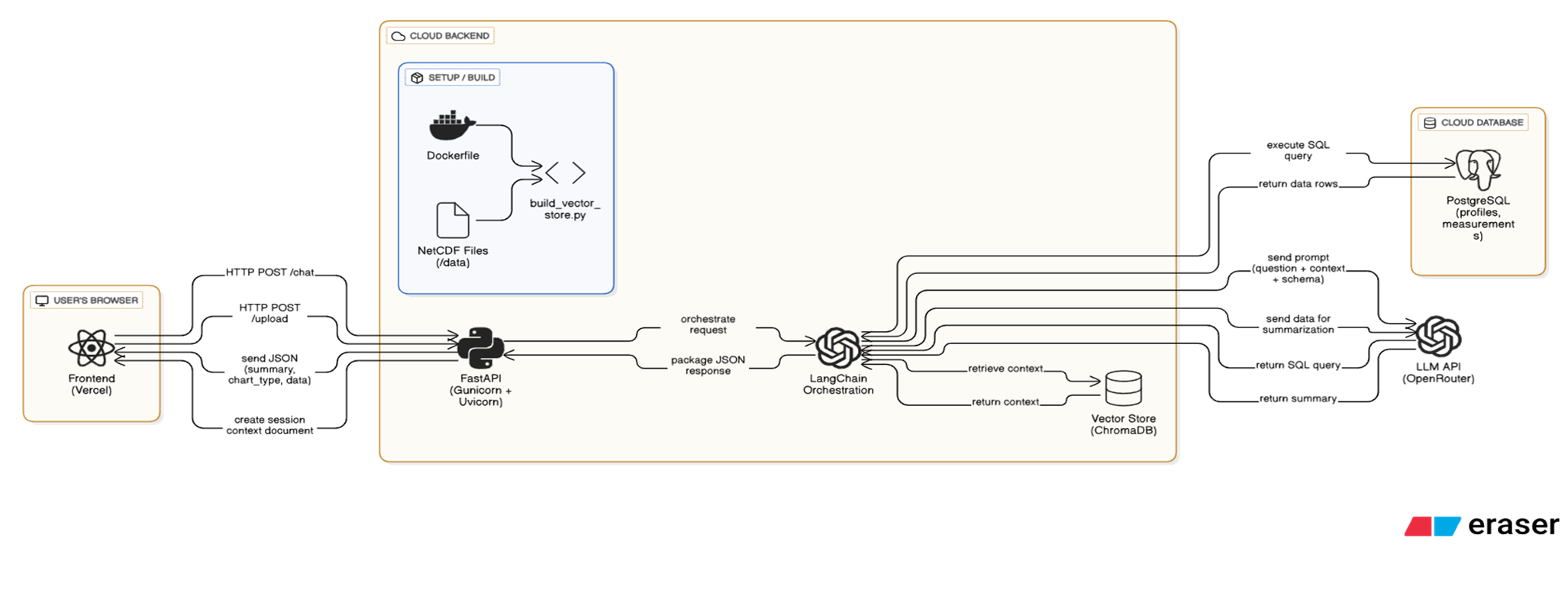
technical workflow
02. Text-to-SQL: An LLM receives the question, schema,
and context
to generate a high-precision SQL query for the relational database.
03. Data Execution: The system executes the SQL
against
PostgreSQL (Supabase) and retrieves raw measurement rows.
04. Insight Generation: Raw data is passed back to the
LLM for
summarization, delivering a human-readable response alongside interactive visualizations.
technical stack
- Frontend: React 18, Tailwind CSS, Vercel, Plotly.js, D3.js
- Backend: Python, FastAPI, LangChain, Docker, Render
- Database: PostgreSQL (Supabase), ChromaDB (Vector Store)
- AI: RAG Pipeline, OpenRouter API (LLM Orchestration)
- Data: NetCDF (Scientific Oceanographic Format)
prototype demonstration
challenges & feasibility
Challenges
- Handling inconsistent schemas in legacy NetCDF files.
- Ensuring zero-hallucination SQL generation for scientific accuracy.
- Optimizing latency for streaming LLM responses.
Feasibility
- Leverages mature orchestration frameworks (LangChain).
- Cloud-native deployment enables effortless scaling.
- Managed infrastructure reduces operational overhead.